Conversational AI and e-commerce: where does AI shopping really stand?
Updated on · By Pascal SCRIVANI
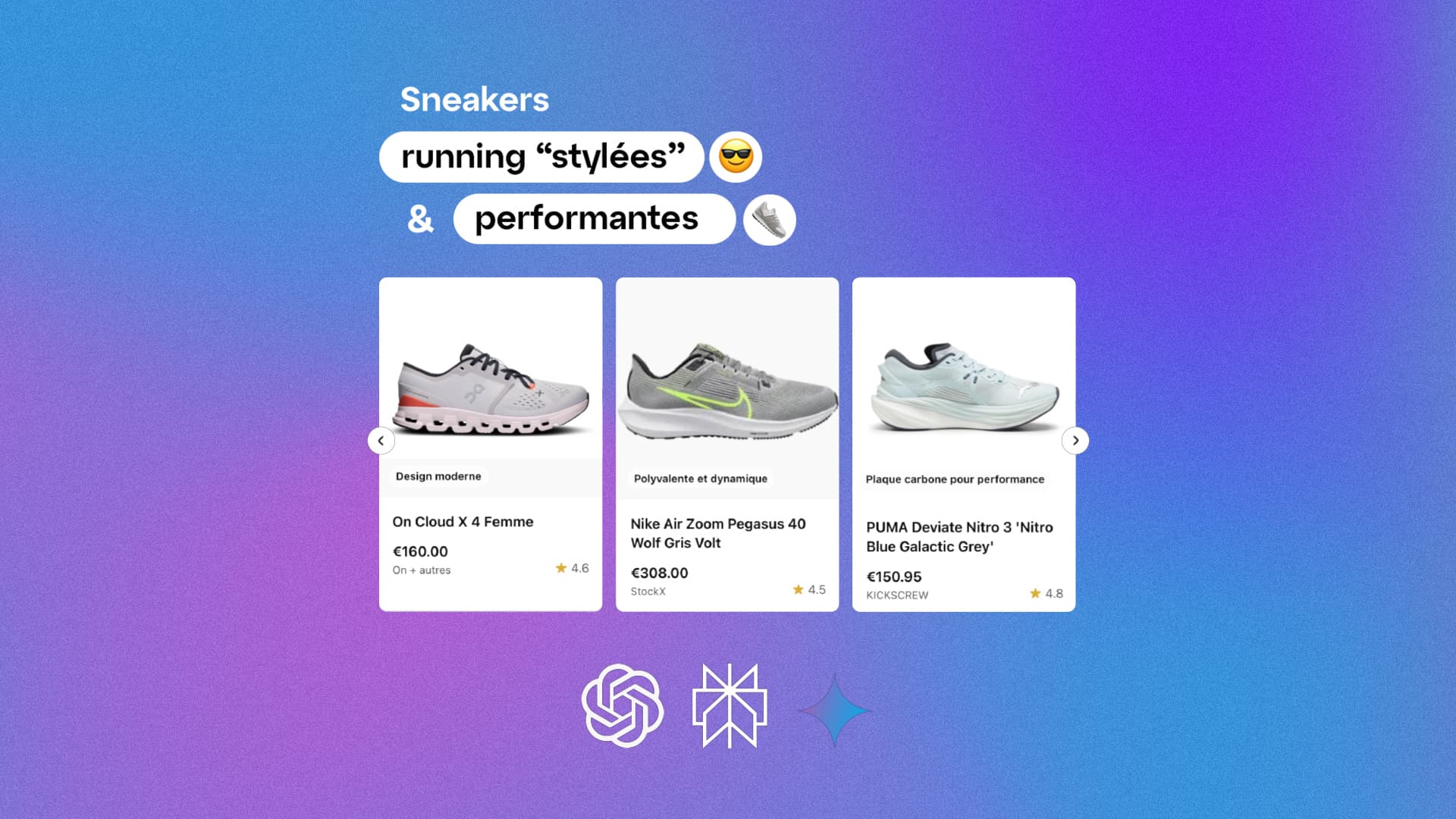
In May 2025, we wrote here that AI was set to become every online shopper's personal salesperson. Since then, ChatGPT has launched and then refocused its built-in shopping, Google has laid down its own rails, and Amazon is fighting it out in the courts. The French situation fits in one sentence: AI gives advice, and the customer still pays on the merchant's site. The ground is being prepared all the same, and fast.
What is conversational commerce?
Instead of typing “women's waterproof coat”, you describe a need: “I'm off on a rainy weekend and I need a coat that's smart but waterproof.” The assistant reads the context and suggests a selection, as a personal shopper would. That part is already very real.
Agentic commerce goes further: an AI agent compares, fills the basket and pays for you. That is where the 2025 story ran into the facts.
ChatGPT, Google, Amazon: where do the giants stand?
OpenAI backs off on payment. In September 2025, Instant Checkout made it possible to buy without leaving ChatGPT, in the United States. Six months later, OpenAI acknowledged that this first version lacked flexibility: merchants are taking back control of payment, and ChatGPT is concentrating on product discovery.
Google is building the rails. In January 2026 it unveiled the Universal Commerce Protocol, a standard for buying from its AI tools. Its universal cart opened in the United States in October 2026, and direct payment arrived in Canada in early November. We found no announcement for France.
Amazon keeps its doors shut. The group is pushing its own assistant, Alexa for Shopping, and blocks many outside agents. It took Perplexity and its Comet browser to court, but in August 2026 a US appeals court overturned the injunction it had obtained. The dispute goes on.
Agentic commerce in France: what is the reality?
The Autorité de la concurrence (France's competition authority) took stock in an opinion dated 17 July 2026: at that point, agents in France stopped short of the purchase and sent people on to the merchant. Five days later, Google launched its AI-generated answers there, with no shopping feature announced.
Retailers are already experimenting. Carrefour has launched an app in ChatGPT for putting a basket together, with payment on Carrefour.fr. Decathlon is watching how the models recommend its products. Customer caution counts too: the Fevad, the French e-commerce federation, cited by the Autorité, notes that shoppers want above all to stay in control (57%), ahead of payment security (46%) and privacy (45%).
How much does AI weigh in online sales?
Not much, for now. Similarweb attributes 0.4% of visits to e-commerce sites to generative AI, and 89% of those who use it for shopping also use traditional search. In France, the Autorité de la concurrence mentions less than 5% of traffic to retail sites, and nearly 25% by 2030 according to some of the players it interviewed.
Usage, on the other hand, is growing fast. According to the Fevad and Odoxa, 31% of French online shoppers use generative AI to make purchases. In the United States, Adobe measured in March 2026 a conversion rate 42% better for visitors arriving from AI, when it had been 38% worse a year earlier. Few people, then, but visitors who know what they want.
Whether the big switch is under way is still up for debate. On 7 May 2025, Eddy Cue, an Apple executive, stated under oath that searches in Safari had fallen the previous month for the first time in 22 years, pointing to AI assistants. Google replied that it was seeing overall growth in its queries, including by voice and from Apple devices.
How do you get your products ready for AI?
Got SEO under control? Now add GEO, for Generative Engine Optimisation: the work that makes a brand visible in AI-generated answers. In 2025 we said that only products AI could “understand” would get put forward. Let us qualify that: Google requires no special optimisation for its answers, and ChatGPT also crawls sites that have no dedicated feed. Good practice remains simple.
Fill out your product pages. Material, size, use, compatibility, availability: a vague page cannot answer a precise question. A clean product feed helps too, starting with Google Merchant Center.
Write descriptions built around context and use. Customers describe a situation: your copy needs to speak to it, as well as listing features.
Look after what others say about you. Reviews, comparisons, press coverage: these pages feed the answers too.
Look for yourself in the answers. Ask ChatGPT, Gemini and Perplexity your customers' questions, and note who comes up. That is the territory of our AI & data analysis team.
Keep the link with your customers. For now, the merchant is still the seller: make the most of it to polish your customer journey. And if you launch your own assistant, test it thoroughly, because a clumsy chatbot can do more harm than good.
The technical side, websites and web systems, is the territory of NATIVBIZ, our group's digital agency.
In 2025, we announced that tomorrow AI would be choosing your products. At the end of 2026, it makes suggestions, and the customer still gets out their card. So your product page has a little time left to learn how to answer.