Design thinking: thinking outside the box, starting from users
Updated on · By Pascal SCRIVANI

Some interfaces seem made to measure. The button is right where you look for it, the form guesses what you want to do, nothing gets in the way. That is rarely by chance: someone watched real users before drawing the first screen. Design thinking formalises this way of tackling problems head-on, so that the solutions it produces are genuinely useful.
What is design thinking?
It is a design method that starts from users’ real needs rather than the project team’s hunches. The design and innovation agency IDEO defines it as a human-centred approach to solving complex problems, one that integrates the needs of people, the possibilities of technology and the requirements for business success.
A good project therefore ticks three boxes: it is desirable for people, feasible with technology and viable for the organisation. Buy-in comes before design, which avoids failed launches and features nobody uses.
How does a design thinking process unfold?
It alternates opening phases, where you explore widely, with closing phases, where you make decisions. The Design Council, the UK’s national adviser on design, represents it as a double diamond in four stages.
Discover. Understand the problem instead of assuming it. Interviews, observation, customer reviews, browsing data, questions received by customer service: you look for the real friction points.
Define. Reframe the challenge based on what you have learnt. Personas, those portraits of typical users, help keep everyone’s motivations and needs in mind.
Develop. Look for several answers to the problem you have defined. Sketches, mock-ups, clickable prototypes: you build fast, so the discussion is about something concrete.
Deliver. Test the shortlisted ideas on a small scale, drop the ones that don’t work, then launch.
The launch opens a new cycle. Once the site is live, analysing behaviour feeds continuous improvement: a digital project lives in permanent beta.
Why observe users rather than ask them what they want?
Because people describe what they know, and rarely what they need. Asked about their ideal website, users often list features they have already seen elsewhere. Watched while using it, they show the exact spot where they hesitate, go back or give up. Stated requests offer leads. Observed behaviour offers proof.
Hence the importance of putting yourself in the user’s shoes: a journey that is obvious to the team that designed it rarely is to someone discovering it.
What qualities should a user experience combine?
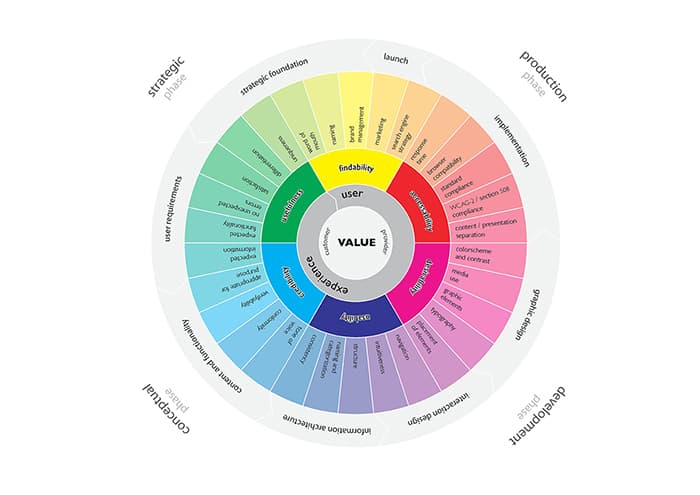
Six, according to the user experience wheel published in April 2007 by Magnus Revang on his blog about user experience. It is still a good checklist for a website, an app or an interactive kiosk.
- Findable: people must be able to reach the service, through a search engine, a social network or an AI answer. That is the SEO manager’s job, and increasingly that of the whole editorial team.
- Accessible: on every screen, and for every user, including those who navigate by keyboard or with a screen reader.
- Desirable: the art direction inspires desire and trust.
- Usable: usability is worked out between designers and developers, from the very first mock-ups.
- Credible: the content, the proof and the brand identity must be convincing.
- Useful: every feature meets an identified need.
What is the difference between UX and UI?
UI, the user interface, is one component of UX, the user experience. The interface brings together the elements that make a product intuitive to use: buttons, menus, fields, icons. On its own, it is mechanics with nothing to say. The experience is only complete with content, a coherent design and an information architecture built around the objectives being pursued.
Take an “Add to basket” button. It comes into its own if the product photo is appealing, if the description highlights the benefits of the offer, if the colour options are easy to read, and if a feature makes it possible to convey the real-life scale of the object. Several disciplines share this simple button:
- interaction design, for an interface that responds to every action, including while things are loading;
- affordance, for elements whose use can be guessed at first glance;
- storytelling, for content that tells the story of the experience;
- emotional design, for an interface that makes people want to come back.
Does design thinking suit every project?
Yes, as soon as there are users, provided you adjust the scale. For a site of a few pages, a handful of interviews and a prototype tested in half a day are enough to head off the costliest mistakes. For a brand website or a campaign, UX and UI methodology becomes part of the communication project. For a platform, an e-commerce site or an app, it structures the entire project, from strategy to launch: that is the territory of NATIVBIZ, the group’s digital agency.
A principle often repeated before a launch sums up the spirit of the method: if you have to explain your concept, it is not ready yet.